Percy Jackson Book vs Series - Season 1; Episode 1: I Accidentally Vaporize My Pre-Algebra Teacher

PART 1: INTRODUCTION
“Look, I didn’t want to be a half-blood. Being a half-blood is dangerous. It’s scary. Most of the time, it gets you killed in painful, nasty ways.”
The Lightning Thief’s opening lines kickstarted the humble beginnings of the Percy Jackson franchise in the most in-character way possible; ripped straight from Percy’s own mundane pulling readers into a world unlike anything they’d witnessed before. These iconic lines firmly establish the tone of not just the first installment, but also the stories to come.
Saying that there was mild skepticism surrounding the Disney+ reboot is an understatement. After the critical failure of the first big-screen adaptations of Rick Riordan’s first two Percy Jackson books, expectations for this fresh revision were sky-high. Some fans were excited for what was promised to be a faithful representation of the books, while others doubted their prowess after the criticisms of the first attempt at book-accurate media. And what was the result of years of patience and theorizing?
The launch of Percy Jackson and the Olympians was met with thunderous success. The series rocketed to the most-viewed TV show on Disney+ in 2021, with high praise from both fans and critics alike. The series was a success.
And now, nearly five years later, how does the series’ pilot episode stand? Were the glowing reviews truly sincere remarks or simply influenced by the whim of a more successful adaptation? I hope, by comparing various changes in plot, scenes, and character translation, to show how, despite mild alterations and critiques, book adaptations can find fresh ways to resonate with viewers, while still honoring the spirit of the original books.
PART 2: BOOK ANALYSIS
Stepping into Rick Riordan’s first entry in the Percy Jackson universe, I’d like to clarify one major point: I love this book. Despite only just reading it fairly recently, it is absolutely, without a doubt, one of the most enjoyable, unique pieces of literature I’ve ever read. From Percy’s humor to the clever allusions to Greek mythology, I was instantly sucked into a story I simply couldn’t put down.
That said, as all fictional tales, it isn’t perfect. I by no means seek to belittle the work put into these one-of-a-kind stories by sharing my problems with certain characters or plot details. I simply mean to expose them in order to scale the quality of the source material and the translation of the series on equal terms. With that, let’s get into it.
Being told from a 1st person point of view, Rick Riordan takes full advantage of Percy’s inner monologue to not only set the mood and theming of the story, but to also sprinkle in important plot and character context in a way perfectly suited for the character. An example of this is in the opening paragraphs when Percy recalls various accounts of him misbehaving at various schools due to his ‘hallucinations’. This is a nice way of showing the fantastical scale behind the inner workings of the world of Percy Jackson as a whole; a place where divine occurrences interlope with everyday events constantly. This also provides the setup for the Yancy field trip incident with Percy, Nancy, and Mrs. Dodds.
Another highlight of the book’s introductory pages is how it establishes Mr. Brunner (soon to be revealed as the mighty Chiron) as more than just another one of Percy’s instructors. He serves as a hidden eye instructing and readying Percy for the uphill battle that comes along with being a half-blood. By establishing Percy’s uncanny fondness for his Latin teacher (a detail absent from the series), it also lays the ground work for an emotionally-conflicting confrontation after the dreaded Yancy incident, before Percy leaves. (I’ll get on with that later, around the ninth paragraph in this section.) In all, the book does an excellent job in showing just why Mr. Brunner pushes Percy to do well in his education, so that he might be fully armored for the trials ahead.
Grover too is given greater detail, as Percy describes his weaker physical state and sensitive emotional condition, despite being a faulty guise to be removed later on. The bit about his muscular disease as a means of hiding his goat legs is a nice touch as well.
When Percy pushes Nancy into the fountain, something I noticed much more in the book than in the series is the students’ reactions. Of course, there’s the initial shock and surprise in the series. But in the book, some comment on how the water from the fountain “grabbed her”, hinting that some of them really did see the truth of what happened. This raises a big question: Does this mean that the Mist doesn’t fully hide every supernatural thing that happens? (Maybe I’m overlooking this, maybe I’m simply not far enough in the series. Nonetheless, this puzzles me.)
Something interesting different in the books is how, after the Yancy incident, Percy isn’t ever expelled from the school. In fact, he returns to the campus directly after the field trip and continues with his everyday life. It’s only when he lashes out upon one of his teachers, after weeks of irritation and questionable behavior, when the news breaks out that he will not be accepted for the following school year. It’s a subtle change, but an important one, nonetheless, as I will show in the next paragraph.
Amidst Percy’s final weeks at Yancy, he awakes in the middle of the night and overhears Mr. Brunner and Grover conversing privately, talking about him, nonetheless. This raises the suspense and mystery of the whole story, as their talks of Percy, Camp Half-Blood, and the attention of the hidden monsters searching for Percy is still a prospect unfamiliar to the audience. As readers, we’re starting to grasp the feel for the tone and feel for what might lie ahead, yet without fully knowing what to expect. Additionally, this exchange does an excellent job of portraying the lengths and responsibility both Grover and Chiron have towards their role as Percy’s guides, seeking to give him as much time as needed to come to grips with the inevitable truth he’ll soon face.
In the book, Percy’s exchange with Mr. Brunner before leaving Yancy serves as a much more influential example of Percy’s feelings of betrayal and loneliness before leaving Yancy behind. As Percy prepares to leave, Chiron makes an attempt to reassure him that this is all for his benefit. He states that Percy is simply different from everyone else at Yancy, though his words come across as dismissive and belittling in Percy’s eyes. This, similar to a specific exchange with Grover in the series (which I will discuss later on in the Series Analysis section), shows the lengths both Chiron and Grover will go to ensure Percy’s readiness for what lies ahead.
Similarly, on the bus back from their field trip, Grover telling Percy he feels the need to “protect him” is shrugged off by Percy as an arrogant generalization on his friend’s part. However, in reality, it’s Grover confiding in Percy that he feels responsible to do whatever he can for the sake of Percy’s benefit. This matches Chiron’s prior sense of responsibility and loyalty to Percy’s journey.
On to one of my biggest gripes about the book: Sally tells Percy that she married Gabe because scent cloaked Percy’s from monsters. I… Really, really don’t understand this. It seems, to me, overly cheesy and simply played for laughs. Additionally, it truly doesn’t even make much sense, as it’s explained in the series that different monsters track via different outlets (fear, self-doubt, etc.), so even then this isn’t a strong explanation.
A point that has been mentioned by many fans alike is Percy’s step-dad, Gabe, is much more aggressive and outright abusive towards Percy and Sally in the books, making a stronger case for him to later be turned to stone. However, this is a double-edged sword, though I’ll wait to touch on this until my episode 8 comparison.
As I’ve shown, through Percy’s inner monologue, the book provides context the show has much more restrictions over. An example of this is in the explanation for Sally’s blue food, a detail absent from the series. While one could advocate for this hindering the series, I feel that this is implied enough as to why this matters to Percy. Also, it serves as fan-service to book fans.
Finally, the book treats the Mist as more of something directly manipulated by the gods and divine beings to cover the otherworldly events from the eyes of the humans. However, in the show, the Mist is much more of a natural force than something able to be influenced. As Grover directly says to Percy,
“We put Mist over the humans’ eyes. We hoped you’d think the Kindly One was a hallucination.”
This is a subtle yet intriguing I change made from the book in the series.
That concludes my thoughts on the book section, as now I’ll move along to my notes on the series.
PART 3: SERIES ANALYSIS
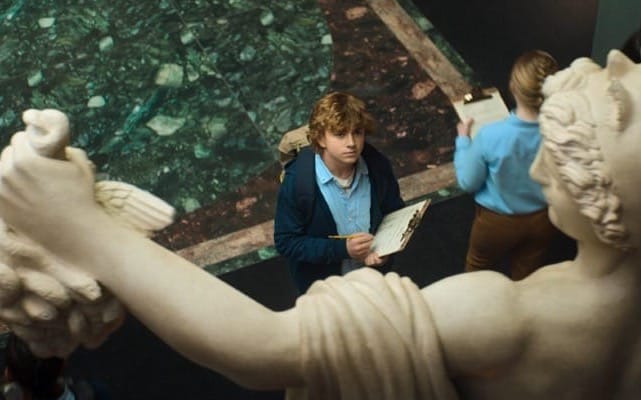
The first noticeable addition the series makes is a flashback with Percy and his mother, Sally, in the New York Metropolitan Museum years ago. They are seen observing a statue of Perseus holding the severed head of Medusa. Here, we get a small, heartfelt exchange between the two, as well as a quote from Sally that perfectly sums up the major theming of the series’ major changes:
“Not everyone who looks like a hero is a hero. And not everyone who looks like a monster is a monster.”
In this same scene, Sally also retells the story of Perseus and his mother’s faithfulness at sea to young Percy. Here, she utters the line, “‘Hold fast, Perseus. Brave the storm that was meant to break us, for we are unbreakable.’” One later repeated before her ‘death’ in the episode’s climax.
After Percy comes back to the present day, and during the fight with Mrs. Dodds, Percy already has his iconic weapon, Anaklusmos, given to him by Mr. Brunner before Dodds attacks Percy. This is a minor change from the book, whereas Mr. Brunner throws Riptide to Percy as soon as he sees Mrs. Dodds advance on him in her Fury form. Personally, I prefer the series iteration of this exchange more, as it’s more reasonable that Chiron had an inkling that Percy would need to be ready to defend himself quickly, rather than waiting until the last second to step in.
The series also adds a scene shortly after this, held in what is presumed to be the principal’s office of Yancy Academy. Not only does this scene provide a cameo for the books’ author, Rick Riordan, it also gives us a compelling interaction between Grover and Percy, as Grover deceptively retells the story of how Nancy ended up in the fountain, ‘betraying’ Percy. This is an excellent example of how Grover tries to do whatever is best for Percy, even ‘abandoning’ his friend, in order to get him where he needs to be: Camp Half-Blood. Additionally, Percy is instead expelled right then and there for his behavior, another change from the source material.
In the series, the three Fates are not shown until the fifth episode, where Annabeth sees them while looking for Percy after the Gateway Arch incident. In the books, when Percy sees the three Fates, it foreshadows Sally’s later death because of the Minotaur. In the series, however, it’s used as a painful warning for Annabeth that one of them would sacrifice themselves later on. (I’ll dig into this later in my episode 5 comparison.)
After Percy returns to Sally and Gabe’s apartment, and after Sally and Percy leave for the beach house, the screen cuts to black before returning to Percy’s dream on the stormy beach, this time showing a ragged, cloaked figure standing on a boat in the water. In the Lightning Thief book, Percy has many, many visions. Some portray the struggle of Zeus and Poseidon, and others focus on Kronos’ trickery and grand plans to tear down Olympus. The series took a similar yet slightly different approach to Percy’s visions, instead focusing on Kronos’ manipulation of Percy. More importantly, it teases the Great Prophecy, something not introduced until The Sea of Monsters. This first vision shows Kronos warning Percy to “run away, before you get hurt.”.
Most of Grover, Annabeth, and Chiron’s exposition on the hidden world and fantastical forces at play in the Percy Jackson universe from the book’s chapters spent at Camp Half-Blood is instead used by Sally at the beach house in the very first episode. This has been heavily critiqued by fans as an ‘exposition dump’, or an instance where the characters are explicitly giving the audience all these details and explanation outright, opposed to us learning from what we see happening. Many fans have criticized that the series should have utilized more “showing, not telling”. However, it makes perfect sense here for Sally to have to sit and explain all these details to Percy before the Minotaur and the following events. Percy knows nothing about this new, unknown world, and neither do most casual viewers. This justifies its inclusion. It isn’t an ‘exposition dump’, as most would think it is, because it makes logical sense for Sally to lay it all out in front of Percy without ambiguity.
During this same discussion at the beach house, in the book, Sally doesn’t know about Mrs. Dodds or the Fates immediately. In fact, she only just finds out when Grover unexpectedly arrives, prompting them to leave for Camp Half-Blood early. However, in the series, it’s implied that she and Grover had conversed on the Yancy incident and had deliberately planned for Percy and Sally to spend the night at the cabin. This was done in the hopes of giving her time to talk things through with Percy, though their plan is cut short by the approach of the Minotaur.
Right after Sally tells Percy the truth in the Greek myths about gods and monsters, Percy interrupts, giving us an interaction sure to break any diehard fans heart:
“I am not a god. There is something wrong with my brain. I understand that I’m weird, believe me, I get it, but I’m afraid something may be really broken now.”
This adds a deep, emotional character moment between Sally and Percy, one that will be built upon later before Sally’s supposed death in the hands of the Minotaur.
Before facing the Minotaur and parting ways with Percy, Sally looks at Percy and tells him:
“Perseus, listen to me. You are not broken. You are singular. You’re a miracle. And you are my son. Hold fast. Brave the storm. I love you.”
Not only is the the foundation upon which Percy finds confidence in his identity, even in the face of the gods themselves, but this is also a line to be repeated in the following episode by Chiron, after Percy is claimed as a son of Poseidon.
In all, these changes just go to show how slight alterations can still remain fresh and valuable, especially when handled by people loyal to the spirit of the source material.
PART 4: VERDICT
Now, where does my personal preference fall? As I’ve said, I adore both the book and the series with all of my heart. The series’ first episode is especially resonant with me, as it was my first introduction to the world of Percy Jackson and the half-bloods. And, while I will continue to0 defend the changes made, and though I adore the heartfelt character interactions shown onscreen, I have to side with the book version.
The key factor leaning me toward the book’s introduction is that it spends a lot more time introducing the world, characters, and mystery soon to be unraveled throughout the rest of the story. You get the chance to fully relish and invest in Percy’s circumstance as he starts to see how different his world is about to become, and Rick Riordan does perfectly at making you feel like you’re there with Percy in person as the plot unfolds. Despite some beautiful character interactions in the series, in particular between Sally and Percy, the book’s more thoughtful pace and establishing tone gives it the edge.
And that’s just about all for this first comparison. If you enjoyed reading through my scatter-brained rants, look out for more Percy Jackson content coming soon. Until then, hold fast, half-bloods.