In Defense of Wicked: For Good

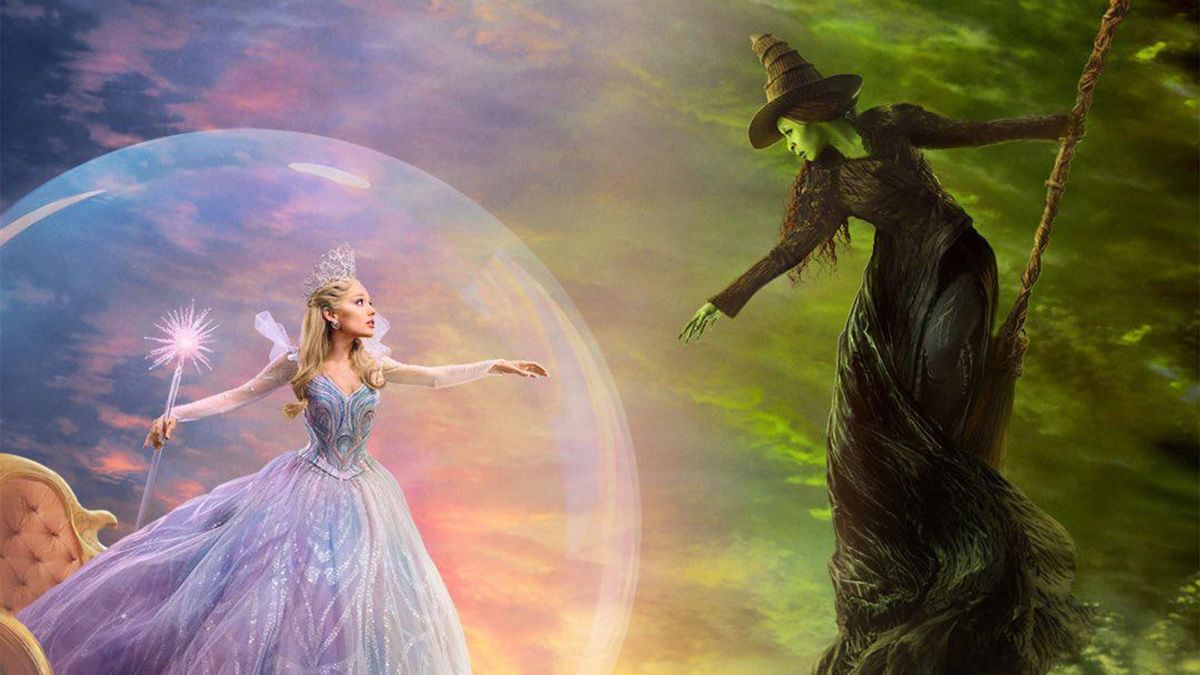
Wicked: For Good was, without a doubt, my most anticipated release from last year, possibly even ever. (Ignoring Beyond the Spider-Verse, of course.) As such, concerning news before I saw the film for myself came after the early-access screenings, when critics remarked how For Good immensely failed to live up to the first film. With a Tomatometer of 66%, a twenty-two point drop from its predecessor. This score spread concern and skepticism right before the film’s full theatrical release, muddying views on whether it was a worthy continuation or if it truly did fall short of Part 1.
Now, with no disrespect to the critics, I couldn’t disagree more. Let me say that I don’t mean to discredit their opinions or anything like that. I simply intend to state a common trend I’ve noticed in the world of movie press: When it comes to critic reviews, you always get a wide range of results. Even with the most widely-loved films, there’s much uncertainty as to how each person will enjoy it. And, of course, everyone is entitled to their own opinion. That should never be taken away from someone, as we can commonly fall into doing in disagreements. That said, I would like to bring up the two central points about Wicked: For Good that will be fundamental to this blog discussion:
- As a film adaptation of the second act of the hit Broadway musical, it follows the structure and events of said act very closely.
- Wicked: For Good greatly focuses on emotional storytelling and satisfying conclusions to plot lines and characters from the first movie, and less so on telling a complex, believable plot.
So, given a large portion of the audience for this film is made up of musical theatre-lovers and longtime (or brand new) fans of the land of Oz, the filmmakers, cast, and producers made it quite apparent their focus was to bring an emotionally resonant close to the storylines of their beloved characters. This movie was not made for praise on its deep storyline or believable timeline. It is, after all, a musical; it is given that plot points and scenes may stretch our imaginations.
As the countless interviews and behind-the-scenes clips clearly show, fan-service was the priority, following a similar pattern as the worldwide phenomenon Spider-Man: No Way Home; which serves a similar example as a film that prioritizes character service over plot structure. Of course, if your main problems with either film are plot-related, that’s totally fair. I simply mean to bring to light the perhaps unconventional priorities of the filmmakers, for the sake of a more personal and impactful narrative. All that said, let’s explore some of the most prominent complaints with Wicked: For Good.
[Spoilers ahead for Wicked: For Good]
Common Criticisms of For Good
WEAK CENTRAL NARRATIVE
One of the film’s major criticisms is how it seemingly boasts a clunky, highly flawed storyline, with its primary focus on character development leading to a weaker structure overall. Whether it be illogical uses of cause and effect, unnatural dialogue, or bloated plot threads, critics centrally critiqued the quality of the narrative as a whole. Now, my response to this has two parts to it, so take it as you will.
Firstly, I believe this response is subjective to the experience and preference of the viewer. It fully depends on if you not only found the film’s character arcs satisfying by their conclusion, but also how you perceive the importance of said character development and its role in the overall narrative, especially at the cost of plot clarity. While some prefer messier, more emotional, character-driven stories, others want to see a complex, well-flowing storyline; full of twists, turns, and thoughtful decisions moving it forward.
Now, as for me, I myself prefer slower, intimate character-focused scenes over a flashy, over complicated plot. (Of course, this depends on the specific example, but the point still stands.) My personal opinion is that we tell stories so we can connect with made up people and share in their struggles, attaching and finding a piece of ourselves in them. So, for me at least, For Good delivered on every bit of unresolved plot given in Part 1: Digging into the aftermath of Defying Gravity, expanding the emotional depth of not only Elphaba and Glinda, but also the Wizard and Fiyero, and tying all of the plot threads into a beautiful conclusion that will stick with me forever.
While I may find my own personal nitpicks with certain moments in the narrative flow of the film as a whole, in particular around the transition from The Girl in the Bubble to Glinda’s failed confrontation with Madame Morrible, these are highly outweighed, for me personally, by the rich character resolution and emotional sequences shown throughout. Essentially, it is absolutely valid to point out your issues with plot lines and for that to bring down the experience for you. For me, they’re insignificant when scaled alongside the more emotional points of the film.
SLOW PACING
Another major complaint is the movie’s uneven pace, with critics claiming that it starts too sluggishly and suddenly gains momentum so quickly that, “you have no time to breathe”. According to their experience, the film elongates certain scenes too much, then breezes through others too rapidly for casual moviegoers.
I would like to give my own initial reaction to the pacing: I have to admit that, while watching the film‘s opening, it certainly felt that it did take a good while for the story to find its tempo, especially in the first half-hour. However, by Wonderful and Glinda’s wedding, the rest of the movie became an absolute thrill ride in the best way possible. The high-speed pace of the story as our characters (Elphaba in particular) spiral into the madness of the climax matches the intensity of what an ideal ending to the story should be: snappy, adventurous, and unsure. Honestly, watching the story unfold from that point onward was an absolute treat, with me finding nearly no issues with pacing or tone afterwards.
CLUNKY TIE-INS TO THE WIZARD OF OZ
Wicked is infamous for the shocking transformations that fuse its second act to the events of the original Wizard of Oz story. Yet, iconic as these twists are, critics claim that the manner in which they occur are sloppy and unpolished, distracting from Elphaba and Glinda’s central stories. Particular examples are the Wicked Witch of the East sequence and the cyclone scene. Critics claim that spending time with Boq and Nessa distracts from Elphaba’s development, and that the cyclone’s appearance and Dorothy’s arrival is played with too cartoonish of a feel to it.
Honestly, I couldn’t disagree more. Primarily, The Wicked Witch of the East sequence’s problem isn’t that they attempt to introduce and expound upon the Tin Man’s appearance; the most glaring issue with it that I see is its expository lyrics. But the concept and execution of the scene is not inherently bad at all; in fact it leads to one of the most intense confrontations of the film, when Nessa comes face to face with the Tin Man. The scene’s problems do not stem from sloppy pacing or turning the story an unexpected direction. In fact, this only adds to the admittedly underdeveloped dynamic between the two sisters, not dragging us away from Elphaba’s main arc.
As for the cyclone scene, I’m shocked by this. How can you complain about one of the most adrenalin-inducing, nerve-racking, epic points of the movie? The mere idea of Madame Morrible being the reason The Wizard of Oz occurred in the first place is a thrill on its own, let alone seeing it on the big screen. And as for the ‘change of tone’, as they call it, I personally found this one of the most engaging moments of the film, not only as a visual spectacle but also a source of emotional connection. Not only do we witness Elphaba’s distress at the mere idea of her sister dying, but this event also serves as a catalyst for the collapse of Glinda and Elphaba’s already shaky bond, before reconciling in For Good. Without the cyclone, we never would have seen their confrontation after the wedding disaster, nor Fiyero’s sacrifice, nor Elphaba’s devastating fall in No Good Deed, one of the emotional high points of the film.
As you can see, I find these complaints about the story’s Wizard of Oz tie-ins bizarre. The film’s ties to The Wizard of Oz are some of the biggest reasons the emotional beats hit so hard. The utter downfall of Boq and Nessarose, the despicable betrayal by Glinda and Madame Morrible, Elphaba’s downfall from moral uprightness, Glinda and Elphaba’s final moment together, and the aftermath of Elphaba’s supposed ‘death’. These tie-ins are what make the emotional payoff so effective.
A WEAKER SOUNDTRACK
Here, I somewhat agree with the critics. The stage performance of Wicked is infamous for a second act regarded as clunky and uneven in levels of quality, in particular with the music. That said, I think the filmmakers did the best with what they could. The main hit numbers from the second half are the powerhouse ballad No Good Deed and the pinnacle that is For Good. As a whole, act two’s songs are known to get a lot less love when compared to the first act’s heavy hitters like The Wizard and I, Dancing Through Life, and Defying Gravity.
Addressing the two original compositions for Wicked: For Good, Wicked’s original composer, Steven Schwartz, cowrote (alongside leads Ariana Grande and Cynthia Erivo) two new inclusions: No Place Like Home, a power ballad Elphaba sings to the animals leaving Oz, and The Girl in the Bubble, Glinda’s reflective turning point after March of the Witch Hunters. These two songs were met with very negative reception, with most viewers claiming they felt out of place and unimportant to plot as a whole. Many have voiced the complaint that the songs lacked meaning in the scope of Elphaba and Glinda’s arcs, as much of the song material had been noticed by fans of the stage play without their inclusion.
Personally, I’d like to say that the new additions weren’t bad, in a vacuum. Cynthia Erivo and Ariana Grande gave overall powerful performance. The songs themselves aren’t bad; it’s when you compare it to the musical style of the rest of Wicked and Wicked: For Good’s soundtrack that they fall short.
Let’s start with No Place Like Home. While both songs left an underwhelming mark on me on my first experience, I initially regarded this as the better of the two. Though, that changed upon revisiting the film and its soundtrack, mainly because of how much of a tonal shift this is compared to the type of song viewers expect from Wicked. Besides that, it also leaves little to no impact on anything that happens, plot or character-wise, for the rest of the film, a major shortcoming.
The Girl in the Bubble was disappointing for me in the theatre likely because of how unclear the lyrics were. I had a very difficult time telling what Ariana was singing as Glinda throughout, though revisiting it afterwards helped my opinion on the song. In my Beneath the Lyrics analysis on No One Mourns the Wicked, I included a few sections with lyrics I’m particularly fond of. As a whole, I am glad the song was included, even if the timeline of that portion of the plot I have issues with. I’m not sure what to say besides it’s a nice song with some neat character moments and lyrics that might take some getting used to. It’s no Thank Goodness or I’m Not That Girl, but it’s serviceable enough to fit in with the rest of the soundtrack.
As a whole, Wicked: For Good’s soundtrack is definitely a step down compared to the first half. I wouldn’t go as far as to call the soundtrack bad, in fact I think it’s still fairly good and replayable. It’s mainly that they had to precede the first half, with some of the most iconic musical theatre songs in history. While the second half’s songs are by no means poor in quality, when put next to hits like No One Mourns the Wicked, What Is This Feeling, and Popular, they are admittedly less substantial altogether. (But I will say that the second half contains some of my favorite Wicked songs of the entire story, such as No Good Deed, Thank Goodness, and the titular For Good.)
So, I’d say I mostly agree with the critics here. While I would by no means resort to calling the songs in For Good bad, they are for certain less impactful overall than Wicked’s soundtrack. (Also, if you’re wondering about the lyric changes made from the stage version to For Good, I’m debating making a separate post about those, so stay tuned.)
CONCLUSION
So, is Wicked: For Good truly a downgrade from Part 1? In my eyes, no. If you were to ask me which film I preferred, I would ultimately respond with, “Both.” And that’s the plain truth; I can’t even try to pick a favorite. And you know why that is? They have such different tones and focuses, I find it unfair to compare the two.
Wicked was all about laying down the groundwork: Introducing our characters, establishing the world and themes at play, getting us invested in the story and cast, and following the classic journey from utter rivals to lifelong friends. Part one was all about beginnings, and how even the most unlikely individuals can change one another. Wicked: For Good is all about the consequences: Where their choices in the previous film put them in the world, how they adapt to public image, and whether they truly know what the right thing even is anymore, leading to bitter betrayal, moral turmoil, and life-changing transformations. We know our two favorite witches have left a long-lasting impact on each other from the first film; now we get to see how that change matters.
This is the beauty of the intermission gap from the first and second films: It gave us a year to contemplate and revisit the world of Oz and what ‘good’ and ‘wicked’ truly are, resulting in an emotional finale that touches hearts for good.